
The hours that never make the schedule
Quick question: how many hours did you spend on hiring last week?
If you had to stop and think about it, that’s pretty normal. Hiring rarely gets its own block on the schedule. It happens in the cracks of the day: a few applications skimmed between lunch and dinner, a callback from the parking lot, a phone screen squeezed into your day off. (Yes, the day off counts.)
Those cracks add up fast. The National Restaurant Association puts a manager’s hiring work at seven to 10 hours a week, and most hourly businesses don’t have a recruiter down the hall to hand it off to. The manager writes the post, reads the applications, makes the calls, and runs the interviews.
So where do all those hours go? We walked through one ordinary week of hiring for a single opening to find out. Swap in your own times as you read and see what your week adds up to.
One opening, one week
Let’s say your weekend line cook just gave notice. (Of course it was on a Friday.) You need someone part time for Friday and Saturday nights, and you need them soon.
Monday: the post (45 minutes)
You dig up the last post you ran, update the pay and hours, and fix the typo nobody caught last time. Post it on a job board or two. Maybe tape a sign to the door for good measure.
Tuesday: the applications (1 hour)
Twenty-some applications come in overnight. About half of them don’t say when the person can actually work. You read each one, sort it into yes, no, or maybe, and then go back through the maybes. Twice.
Tuesday to Thursday: the callbacks (2 hours)
Here’s where the week really gets away from you. Applicants don’t answer calls from numbers they don’t recognize (honestly, do you?). So you leave a voicemail, send a text, and try again tomorrow. Phone tag was a lot more fun when it was just tag.
Meanwhile, the clock is running. According to the NRA, hourly job seekers apply to 10 to 15 positions a week. Every day you spend waiting on a callback is a day another employer can make them an offer.
Wednesday and Thursday: the phone screens (1 hour)
You finally reach six people and ask each one the same handful of questions. Can you work Saturdays? How will you get here? When can you start? Two of them can’t work the hours you need, which you would have known on Tuesday if they’d filled in the availability box.
Thursday and Friday: scheduling (1 hour)
Now you need a time that works for you and for them. That’s a few rounds of texts per person, plus at least one reschedule.
Saturday: the interviews (1.5 hours)
Four interviews at about 20 minutes each. One person doesn’t show, and you wait 10 minutes before giving up and heading back to the line.
The following week: the offer (45 minutes)
You call your pick, chase down their paperwork and start date, and let the other candidates know. Done… until the next person gives notice.
Add it up
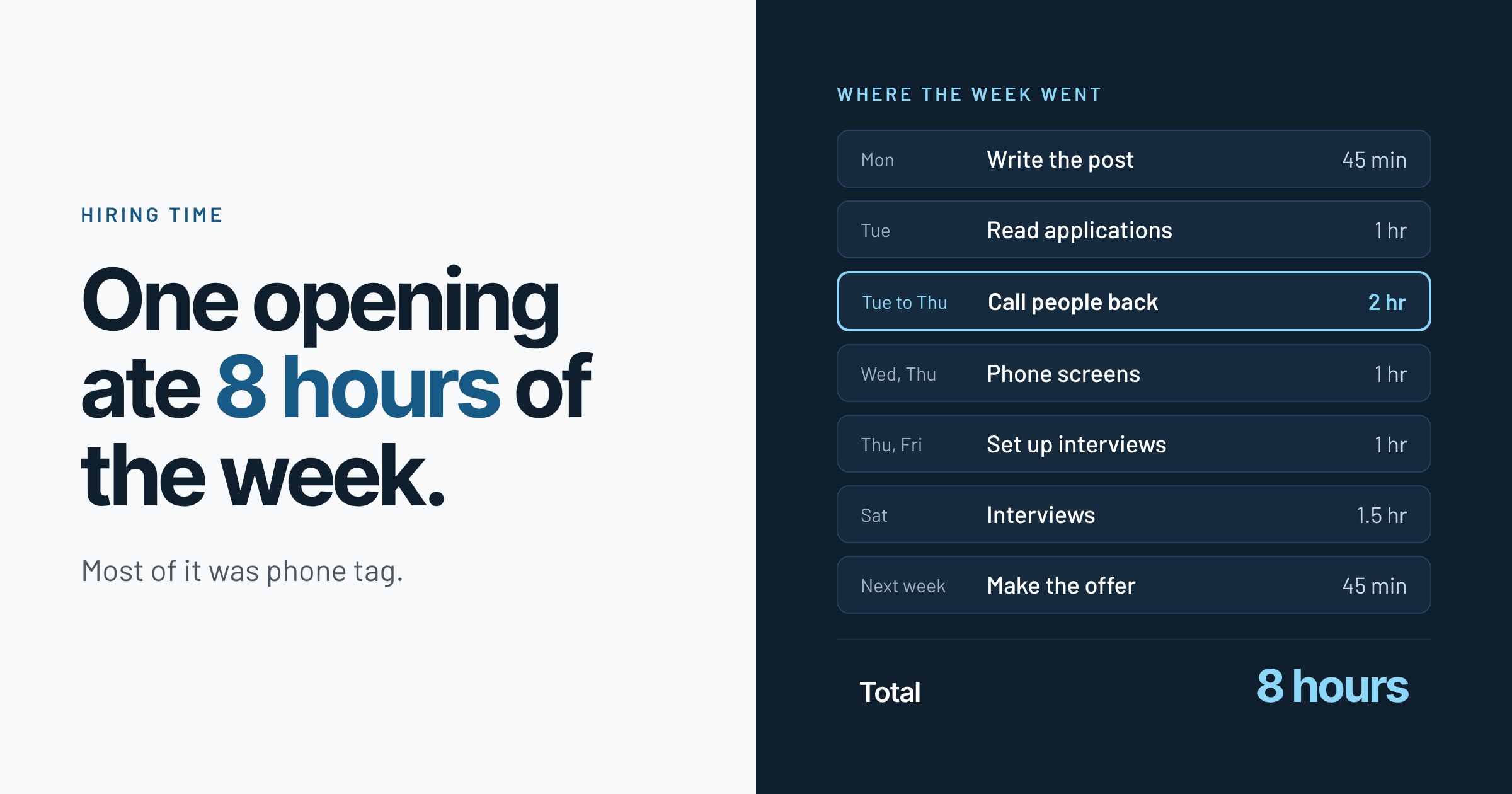
One opening took 8 hours. Five went to sorting and chasing applicants.
Example week: 8 hours of manager time, 5 of them work Hire This Week can take on
- Write and post the job (Mon)45 min, stays with you
- Read applications (Tue)1 hr, Hire This Week can take it
- Call people back (Tue to Thu)2 hr, Hire This Week can take it
- Phone screens (Wed, Thu)1 hr, Hire This Week can take it
- Set up interviews (Thu, Fri)1 hr, Hire This Week can take it
- Interviews (Sat)1.5 hr, stays with you
- Offer and follow-up (Next week)45 min, stays with you
That’s eight hours, a full shift, for one opening in a good week. Add a second opening, or a new hire who doesn’t show up on day one, and it can easily double.
The open shift costs you, too. The NRA found it takes restaurants an average of 16 days to fill an hourly position. One restaurant’s HR director estimated that being short a single server cuts sales by $800 to $1,500 per meal period. While your post sits waiting on callbacks, somebody on your crew is pulling a double, or the shift just runs short.
Want to run the numbers for your own location? Try our ROI calculator. Then think about what else your manager could be doing with that time.
What actually needs you
Look back over that week and ask one question about each task: does this need the manager’s judgment, or does it just need someone’s time?
The judgment list is pretty short:
- The job itself. You set the pay, the hours, and what a candidate has to have.
- The shortlist. You decide who’s worth meeting.
- The interview. Nobody else can tell you whether someone will mesh with your crew.
- The offer. You make the call.
Everything else is mostly time. Sorting applications, chasing callbacks, asking the same screening questions, and trading texts to find an interview slot don’t get done any better because a manager does them. They just get done later, whenever the manager finally has a free hour. By then, a lot of good applicants have already said yes somewhere else.
Handing off that work leaves the hiring decision right where it belongs, with you. All you give up is the phone tag.
Hand off the chase
That’s the gap Hire This Week was built to fill: everything between “someone applied” and “someone is ready to interview.”
It starts with a text. Answer a few questions about the opening, and Hire This Week drafts the job post for you to review and approve. Then it can publish the post to job boards and pull every applicant into one place.
From there:
- Every application gets scored against the criteria you set, like availability, certifications, or how far someone lives from your location.
- Qualified applicants get a text, then a quick phone screen from Rita, our AI screener. She tells candidates up front that she’s automated and calling on your behalf, and most calls wrap up in two to four minutes. Anyone who’d rather pick a time can book one through a link. If Rita can’t reach someone after three tries, they’re flagged for you.
- Shortlisted candidates book their own interviews. No more texting back and forth to find a slot.
- You make the call. You’ll see each score with the candidate’s own words next to it, and you can listen to any screening call before you decide who to meet.
In our example week, that covers Tuesday through Friday: the sorting, the callbacks, the screens, and the scheduling. That’s about five of the eight hours. You keep the post approval, the interviews, and the offer.
Five hours is most of a Saturday. Want it back? Hear a sample AI call or sign up to set up your first job post.